You have probably noticed that AI conversations have changed in 2026. It is no longer just about chatbots that answer questions. The biggest companies in the world — Google, Microsoft, OpenAI, Anthropic — are all racing toward something called agentic AI.
But what does that actually mean? And why does it matter to you?
Here is a plain-English explanation.
The Old AI vs. the New AI
Think of the AI most people used in 2023 and 2024 like a very knowledgeable assistant sitting on the other side of a desk. You asked it a question. It gave you an answer. You asked another question. It answered again.
Every interaction was a single exchange. You drove. The AI responded.
Agentic AI flips that model.
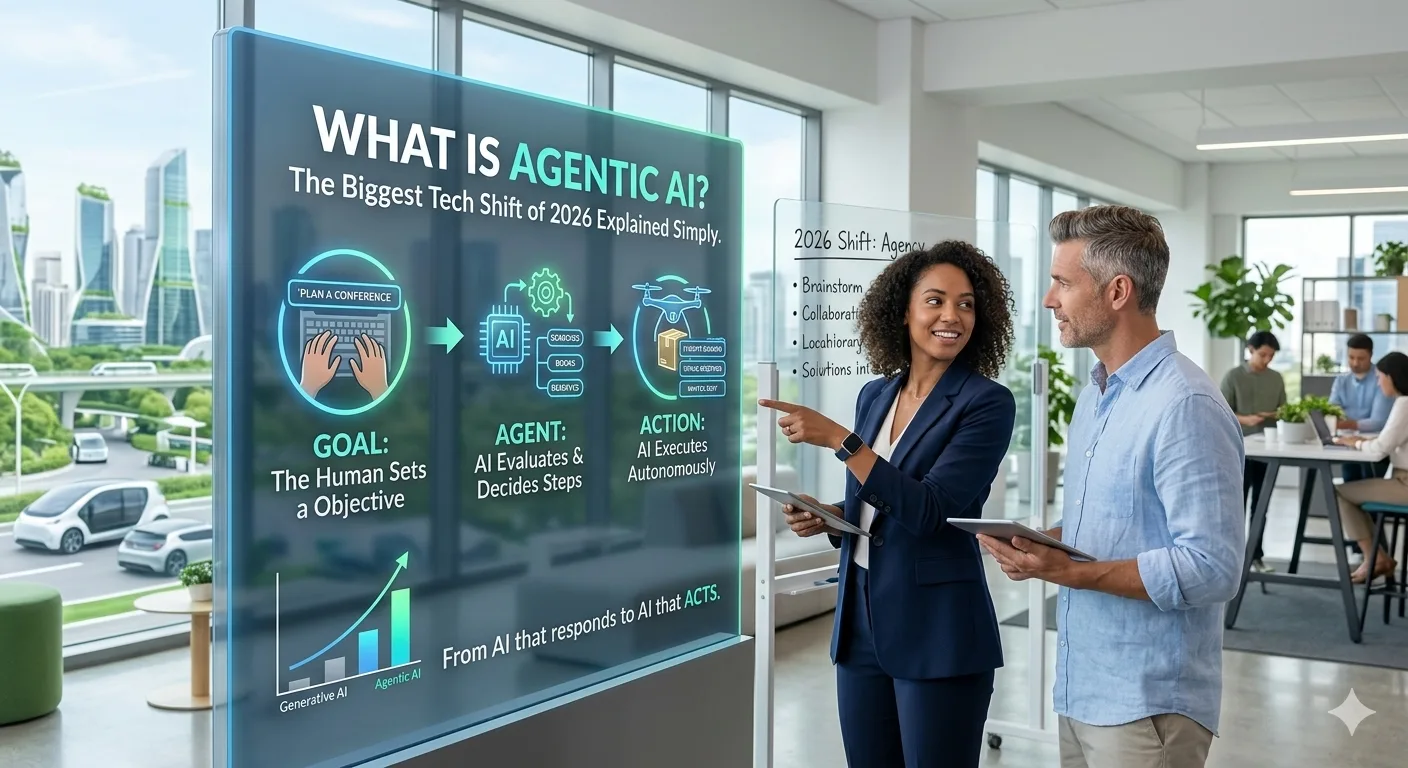
An AI agent does not just respond to your prompts — it plans, makes decisions, uses tools, completes tasks over time, and reports back when the work is done. Instead of you doing the driving, you give the AI a destination and it figures out the route, handles the obstacles, and gets there.
Think of the difference like this: the old AI was like a calculator. Agentic AI is like a capable employee.
A Real Example of What Agentic AI Can Do
Here is a concrete example to make this less abstract.
Imagine you ask an agentic AI: “Research the top five competitors in our market, compare their pricing, find any recent news about them, and put together a summary presentation.”
An older chatbot would start writing based on what it already knew and stop when you stopped asking.
An agentic AI would:
- Search the internet for current competitor information
- Navigate to competitor websites and extract pricing data
- Search for recent news articles about each company
- Organize all of this into a structured document
- Format and deliver the final output
No hand-holding required at each step. No five separate prompts. One instruction, end-to-end completion.
This is why the industry is so excited — and why businesses and workers are paying close attention.
The Companies Leading the Charge
Virtually every major AI company announced agentic capabilities in 2026, but a few stand out.
Google launched Gemini 3.5 Flash at I/O 2026 explicitly as an “agent-first” model. The company said it signals a shift from AI as a conversational tool to AI as an agentic tool. The model can independently execute coding pipelines, manage research projects, and in internal tests, built an operating system from scratch with minimal human input. Google also launched Gemini Spark, a personal AI agent designed to run 24/7 and manage your digital life.
Microsoft announced MAI-Thinking-1 at Build 2026, its own reasoning model built specifically for complex multi-step instructions and long-horizon tasks — the hallmarks of agentic work. It also updated GitHub Copilot to function as an entire agentic development environment, where AI agents collaborate with developers throughout the software development lifecycle.
OpenAI has been building out its own agent framework, with tools that allow AI to take actions in browsers, write and run code, manage files, and interact with external services on your behalf.
The race is real, and it is moving fast.
What Makes Agentic AI Different Under the Hood
For the technically curious, the key ingredients that make an AI agent work are:
Planning — The ability to break a complex goal into a series of steps and figure out the right order to tackle them.
Tool use — Connecting to external resources like search engines, databases, APIs, calendars, email, or code editors to take real-world actions.
Memory — Keeping track of what has already been done within a task, so the agent does not lose context midway through a long job.
Self-correction — Checking its own work, noticing errors, and adjusting the approach without being explicitly told to.
None of these capabilities are new on their own, but combining them reliably in one system — and deploying that system at scale — is what 2026 is making possible for the first time.
The Benefits for Businesses and Individuals
The impact of agentic AI on productivity is already being documented. According to a PwC survey, 66% of companies using AI agents report measurable productivity gains. Workers using agentic tools are reclaiming more than six hours per week by delegating routine work. Development teams report completing workflows 30 to 60% faster.
For small business owners and freelancers, agentic AI tools can effectively act as a part-time assistant that handles research, scheduling, content drafting, data analysis, and customer query handling — all at a fraction of the cost of hiring additional staff.
For larger organizations, agentic AI opens the door to automating entire business processes end-to-end: from lead generation to contract drafting, from customer onboarding to financial reporting.
The Concerns Worth Taking Seriously
Agentic AI also raises genuine concerns that should not be brushed aside.
When AI systems take autonomous actions — sending emails, making purchases, modifying files, or interacting with third-party services — mistakes can have real consequences. An AI agent that misunderstands a goal, encounters an unexpected situation, or has access to more systems than it should can cause significant damage before a human notices.
There are also questions about accountability. When an AI agent makes a decision that causes harm, who is responsible — the user, the company that built the model, or the company that deployed it?
Regulatory frameworks around the world are actively grappling with these questions. The EU AI Act, which came into force in 2025, is already beginning to address requirements for human oversight of autonomous AI systems.
What This Means for You in 2026
Whether you are a student, a professional, a business owner, or just a curious person trying to keep up with a fast-moving world, agentic AI is going to touch your life more in the next 12 months than it has in the past three years.
The tools are getting easier to use. The capabilities are expanding rapidly. And the gap between those who understand how to work with agentic AI and those who do not is starting to widen in ways that will matter professionally and financially.
The good news is that you do not need to become an AI engineer to benefit. You just need to understand what these tools can do, stay curious about how to apply them to your own work, and be thoughtful about when human judgment still matters more.
That balance — AI doing the routine, humans doing the judgment — is where the opportunity lives in 2026.
Sources: TechCrunch, Google I/O 2026 announcements, Microsoft Build 2026 announcements, PwC AI Agent Survey 2025, RecomAI (2026)