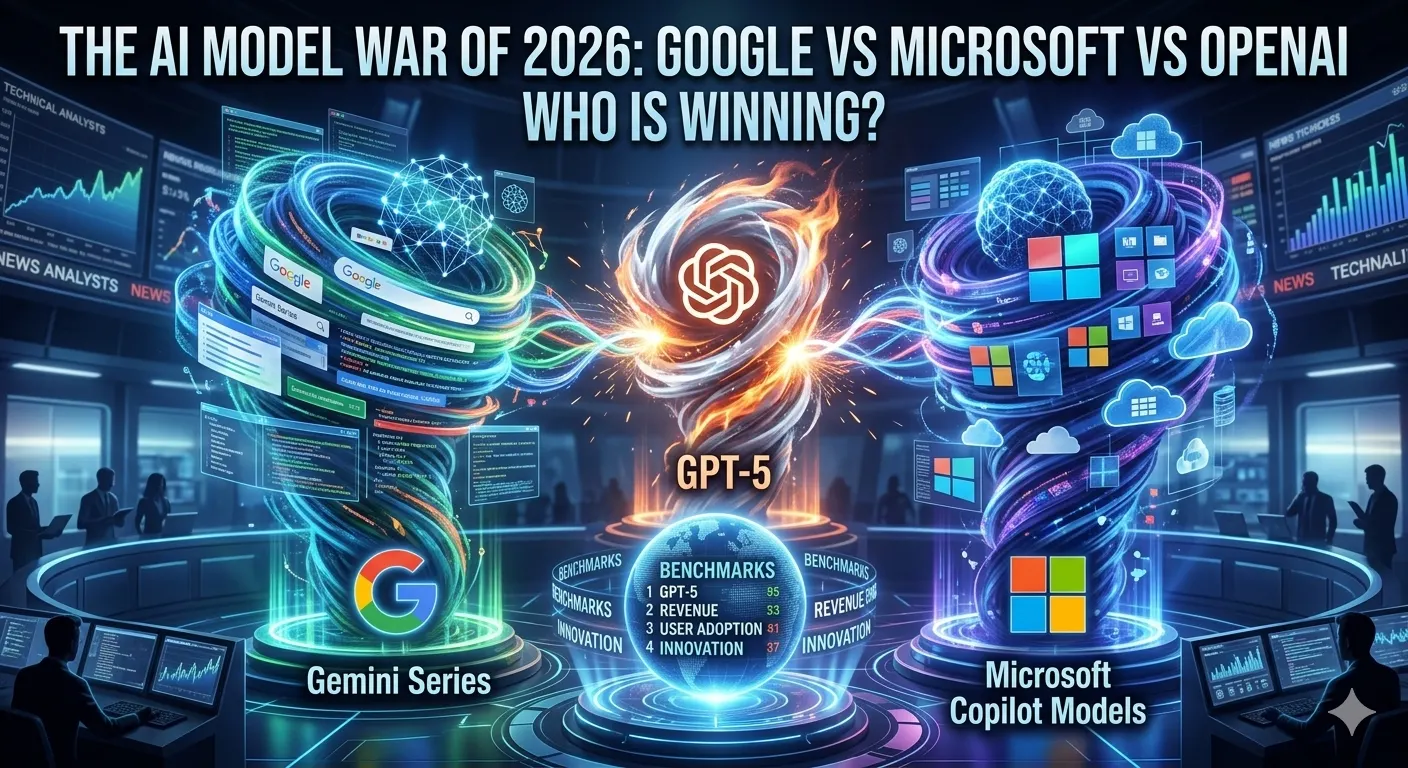
Three years ago, OpenAI launched ChatGPT and started a revolution. In 2026, the revolution has become a full-scale war.
Google, Microsoft, OpenAI, Anthropic, and a growing list of challengers are launching new AI models at a pace that would have seemed impossible just eighteen months ago. On average, a new major AI model now appears every three days.
For anyone trying to keep up — whether you are a developer, a business owner, or just an interested person — it is overwhelming. So here is a clear breakdown of where each major player stands right now, and what it means for you.
The Current Leaderboard (As of June 2026)
Before diving into each company, here is the quick snapshot of the most significant recent model releases:
| Company | Model | Key Strength |
|---|---|---|
| Gemini 3.5 Flash | Speed + agentic tasks | |
| Microsoft | MAI-Thinking-1 | Reasoning + enterprise |
| OpenAI | GPT-5.5 Instant | Broad capability |
| Anthropic | Claude Opus 4.8 | Coding + safety |
| Alibaba/Qwen | Qwen 3.5 | Open-weight, cost-efficient |
| xAI | Grok 4.20 | Multi-agent architecture |
The gap between the top models has narrowed dramatically. What was a clear hierarchy in 2023 has become a genuine competitive race in 2026.
Google: Betting Everything on Agents
Google’s big move in May 2026 was Gemini 3.5 Flash, launched at Google I/O. What made the announcement remarkable was not just the model’s performance — it was what the model is designed to do.
Google’s strategy has shifted decisively from “AI that answers questions” to “AI that completes work.” Gemini 3.5 Flash is built to run coding pipelines autonomously, manage long research projects, and handle complex multi-step tasks with minimal human direction. Google’s own chief technologist said it outperforms the previous Pro-tier model on nearly every benchmark, at four times the speed.
Google also rolled this model out to billions of users immediately — through the Gemini app, Google Search’s AI Mode, and the Gemini API. This is Google’s biggest advantage: unmatched distribution. When Google launches a model, it reaches more people faster than any competitor.
The company also launched Gemini Spark, a personal AI agent designed to run continuously in the background and manage your digital life around the clock.
Google’s bet is clear: the future of AI is agentic, and Google wants to own that layer at consumer scale.
Microsoft: Going Independent
For years, Microsoft was essentially the public face of OpenAI — pouring billions into the startup and baking ChatGPT into every product from Bing to Word. That relationship is evolving, and Microsoft’s Build 2026 conference signalled a major strategic turn.
The headline announcement was MAI-Thinking-1 — Microsoft’s first reasoning model built entirely in-house, without using any distilled outputs from OpenAI or any other external partner. With 35 billion parameters and a context window of up to 256,000 tokens, it is designed for the complex, long-document tasks that enterprise clients need most.
Microsoft claims independent reviewers preferred MAI-Thinking-1 over Anthropic’s Claude Sonnet 4.6, and that it matches Claude Opus 4.6 on coding benchmarks. Perhaps more importantly, by running models on its own Azure infrastructure instead of licensing from OpenAI, Microsoft says developers can access the same capability at roughly one-tenth the cost of GPT-5.
Beyond the flagship reasoning model, Microsoft launched six additional models covering image generation, speech transcription, coding assistance, and voice synthesis — building a complete in-house AI stack for the first time.
The strategic goal is straightforward: reduce dependence on any single AI partner and gain full control over the cost, capability, and direction of the AI powering its products.
OpenAI: Defending the Top Spot
OpenAI remains the most recognized name in AI, and its models continue to set benchmarks that competitors race to match. GPT-5.5 Instant launched as a fast, capable model covering broad use cases, while the company continues development on more advanced systems.
OpenAI has also been investing heavily in agentic infrastructure — building frameworks that allow AI to take actions in browsers, write and execute code, manage files, and interact with external services autonomously.
The challenge for OpenAI is defending its premium positioning in a market where competitors are delivering comparable performance at significantly lower prices. Microsoft’s MAI-Thinking-1 explicitly competes on a cost-per-result basis, not just raw capability.
The company also faces growing scrutiny around safety and governance as its models become more autonomous and widely deployed.
Anthropic: The Safety-Focused Challenger
Anthropic — the company behind the Claude family of models — has positioned itself as the AI company that takes safety most seriously. Its latest model, Claude Opus 4.8, continues to score highly on coding and reasoning benchmarks.
Anthropic’s models are frequently used as comparison points by competitors, which is itself a form of validation. Microsoft’s MAI-Thinking-1 launch explicitly benchmarked itself against Claude models. That kind of competitive reference suggests Anthropic has built a strong reputation in the developer and enterprise communities.
The company’s focus on “constitutional AI” — building safety and value alignment directly into model training — has attracted significant enterprise clients who are nervous about deploying AI systems that can take autonomous actions without guardrails.
The Open-Weight Challengers: Qwen, Grok, and Others
One of the most significant trends of 2026 is the rise of strong open-weight and open-source models that challenge the dominance of proprietary systems.
Alibaba’s Qwen 3.5 continues to pressure closed-model vendors, offering strong performance at lower cost with the flexibility of local deployment. For companies concerned about data privacy, the ability to run a capable model on your own infrastructure — rather than sending data to a third-party API — is increasingly attractive.
xAI’s Grok 4.20 pushed conversations about multi-agent architectures, where multiple AI systems coordinate to complete complex tasks together, rather than relying on a single model.
These challengers matter because they keep pricing competitive and democratize access to capable AI for organizations that cannot afford the top-tier proprietary models.
What Actually Matters for You
With so many models launching so quickly, it is easy to lose sight of what matters in practice.
For most everyday users, the model differences are less important than the tools built on top of them. The Gemini app, Microsoft Copilot, ChatGPT, and Claude are all becoming significantly more capable — and the underlying model powering them will continue to improve rapidly.
For developers and businesses choosing which AI platform to build on, the key questions in 2026 are:
Cost per task — Not just the price of the API, but the total cost to complete a specific workflow at the quality you need.
Reliability in the real world — Benchmark scores tell one story; consistent performance on actual business tasks tells another.
Integration with your existing tools — The model that works best inside your existing workflow is often more valuable than the model with the highest score on an academic test.
Safety and oversight — As AI systems take more autonomous actions, the guardrails and accountability mechanisms matter enormously.
The Bottom Line
The AI model war of 2026 has no clear winner yet — and that is actually good news for users.
Competition is driving down prices, pushing capabilities forward faster than anyone predicted, and forcing every company to make genuine innovations rather than incremental refinements. The pace of progress is extraordinary: capabilities that seemed like science fiction in 2023 are now standard features.
The race is not slowing down. If anything, it is accelerating.
Sources: Microsoft Build 2026, Google I/O 2026, TechCrunch, AI Flash Report (June 2026), MarkTechPost, Windows Report