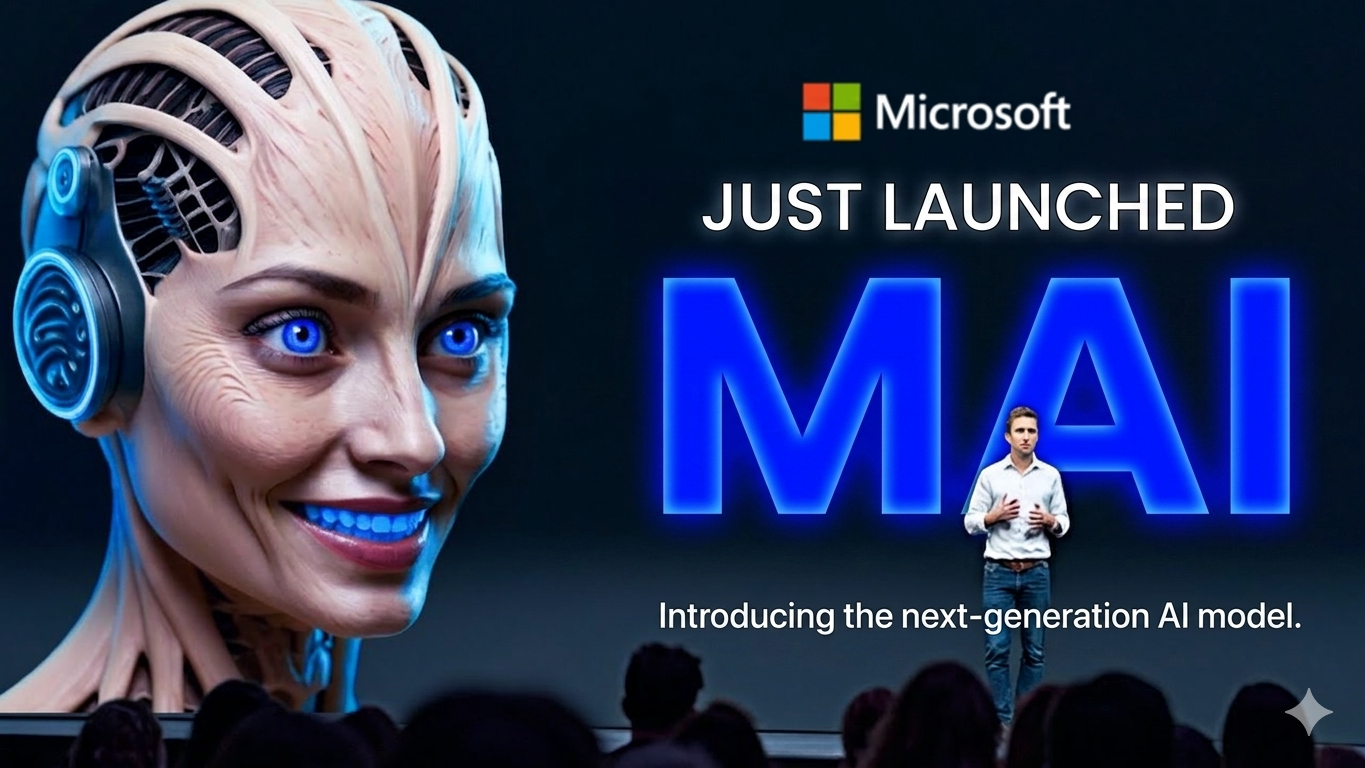
The AI race just got a new player — and this time, it’s Microsoft going fully in-house.
At its annual Build 2026 developer conference in San Francisco, Microsoft unveiled MAI-Thinking-1, its first homegrown reasoning AI model. This is not just another incremental update. It is a bold statement that Microsoft is serious about building its own artificial intelligence from scratch — without relying on OpenAI, Anthropic, or any other external partner.
Here is everything you need to know.
What Is MAI-Thinking-1?
MAI-Thinking-1 is Microsoft’s flagship AI reasoning model, developed entirely in-house by the company’s AI Superintelligence team. The “MAI” stands for Microsoft AI, and this new model family marks a major shift in how the tech giant approaches artificial intelligence.
Unlike many AI models that are built by fine-tuning or distilling outputs from existing systems, Microsoft says MAI-Thinking-1 was trained completely from scratch using clean, commercially licensed, enterprise-grade data. No shortcuts. No borrowed brains.
The Numbers Behind the Model
For the tech-savvy readers, here are the key specs:
- 35 billion active parameters — making it a medium-to-large scale model
- 128K–256K token context window — meaning it can read and understand extremely long documents in one go
- Built for complex multi-step reasoning, code generation, and long-context tasks
- Available in private preview through Microsoft’s Azure AI Foundry platform
A large context window is a big deal. It means the model can hold entire legal contracts, research papers, or codebases in its “working memory” while generating responses — something that matters enormously for real business use cases.
How Does It Compare to Other AI Models?
Microsoft made some bold claims at the Build 2026 keynote. According to the company:
- MAI-Thinking-1 matches Anthropic’s Claude Opus 4.6 on coding tasks in the SWE Bench Pro benchmark
- In blind evaluations conducted by independent reviewers, the model was preferred over Anthropic’s Claude Sonnet 4.6
- It offers a tenfold cost saving compared to GPT-5, because Microsoft runs it on its own Azure infrastructure instead of paying licensing fees to external vendors
That last point is especially important. By building its own model, Microsoft avoids paying royalties to partners, and those savings can be passed directly to developers and businesses using the platform.
It Is Not Just One Model — It Is a Whole Family
MAI-Thinking-1 is the headline act, but Microsoft announced seven new MAI models at Build 2026. The full lineup includes:
MAI-Image-2.5 — A text-to-image and image-to-image model already available inside PowerPoint and rolling out to OneDrive soon.
MAI-Image-2.5 Flash — A faster, lighter variant of the image model, currently ranking second on the Arena AI leaderboard.
MAI-Transcribe-1.5 — A speech transcription model claiming state-of-the-art accuracy across 43 languages.
MAI-Code-1 — A coding-focused inference model now live inside GitHub Copilot and Visual Studio Code.
MAI-Voice-1 — A speech generation model capable of producing a full minute of audio using a single GPU in less than a second.
Together, these models cover nearly every type of AI task a business might need — writing, seeing, hearing, speaking, and coding.
Why Is This a Big Deal?
For years, Microsoft has been deeply tied to OpenAI, investing billions of dollars and baking ChatGPT-powered features into its products. That partnership remains in place, but cracks have appeared, and Microsoft has been quietly working toward greater independence.
MAI-Thinking-1 is the clearest sign yet that Microsoft no longer wants to depend on any single AI provider. By owning its own models, the company gains:
- Cost control — No royalty payments to third parties
- Data privacy — Training data is clean and commercially licensed, which reassures enterprise clients
- Flexibility — Models can be customized and deployed across Microsoft’s entire product ecosystem
Microsoft has also confirmed that MAI models will soon appear on third-party platforms including Fireworks AI, Baseten, and OpenRouter, broadening their reach beyond Microsoft’s own services.
What Do Developers Think?
Reactions from developers attending Build 2026 in San Francisco were largely positive. Many praised the transparency of MAI-Thinking-1’s reasoning chain — meaning users can see how the model arrived at its answers, step by step. Microsoft also announced plans to open-source some models in the MAI family, which has been welcomed by the developer community.
Some raised questions about the omission of China as a supported inference region and noted that MAI models remain subject to Microsoft’s content moderation policies, which can be stricter than those of some competitors.
What Comes Next?
Microsoft is not stopping here. The company has outlined a clear roadmap:
- A series of live “AI Q&A” sessions throughout summer 2026 to gather developer feedback
- An API for custom fine-tuning with sensitive enterprise data, using confidential computing enclaves, entering public preview in Q3 2026
- MAI-Thinking-1 is currently in private preview; a broader rollout on Azure AI Foundry is expected in the coming months
The Bottom Line
Microsoft’s MAI-Thinking-1 is more than a new AI model. It is a declaration of independence. After years of depending on OpenAI’s technology to power Copilot, Bing, and its developer tools, Microsoft is now building AI on its own terms.
Whether MAI-Thinking-1 will truly outperform the best models from OpenAI, Google, or Anthropic in real-world use remains to be seen. Benchmarks tell one story; everyday reliability tells another. But the ambition is clear, the technical foundation is solid, and the cost advantages are real.
For businesses, developers, and anyone who uses Microsoft products — this launch matters. AI is moving from something you access through a subscription to something baked into the infrastructure of every tool you use. MAI-Thinking-1 is Microsoft’s bet that it should own that infrastructure itself.
Keep watching this space. The AI race in 2026 is moving faster than ever.
Sources: Microsoft Build 2026 official announcements, Windows Report, Republic World, News9Live, TechTimes (June 2026)
Tags: Artificial Intelligence, Microsoft, MAI-Thinking-1, Build 2026, AI Models, Azure, GitHub Copilot, Technology News
Meta Description: Microsoft unveiled MAI-Thinking-1 at Build 2026 — its first homegrown reasoning AI model with 35 billion parameters. Here’s what it is, how it works, and why it matters.